

Why Women Need This
For most of human history, women did not face life alone.

Extended family surrounded them. Neighbors knew them by name.
Generations of women gathered — to cook, to raise children, to grieve, to celebrate, to simply be together in the rhythms of life. That structure held women. It nourished them in ways they rarely had to ask for, because it was simply there.
That structure has quietly disappeared. Families are scattered across cities and countries. Communities have moved online in ways that mimic connection without delivering it. Women are busier than ever, and more isolated than ever — often at the same time.
What remains is a hunger most women cannot quite name,
only feel: a longing for something real, consistent, and genuinely their own.
Connection is not a luxury — it is a biological need
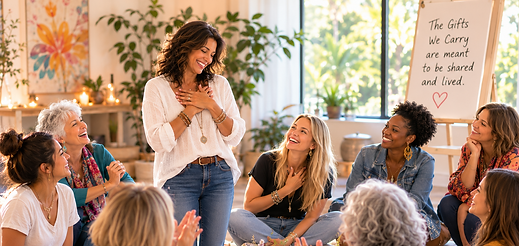
A woman is wired for connection.
This is not sentiment, it is biology, neuroscience, and lived reality all pointing to the same truth.
Research now confirms what women have always known in their bodies:
when we are genuinely connected - seen, heard, and belonging somewhere - we are healthier, more resilient, and we live longer. When that connection is absent or shallow,
the consequences are not just emotional. They show up in our immune systems,
our hormones, our hearts, our sleep, and our capacity to cope.
Loneliness in women is not a personal failing. It is a health crisis.
Studies link chronic social disconnection to higher rates of depression, heart disease, cognitive decline, and significantly reduced life expectancy. The science is clear: an isolated woman is a woman whose health is quietly eroding, whether she names it that or not.
Women are the emotional center — and they are running on empty
There is a second layer that makes this even more urgent.
In most families, it is the woman who holds the emotional life of the household. She attunes, regulates, holds, and tends — to her children, her partner, her aging parents, her friends. She does this largely without being replenished herself.
A woman with no community of her own to return to — no space where she is the one being held — cannot sustain this giving for long without cost. The quality of her presence in her family, her marriage, and her own life gradually diminishes. This is not a character flaw. It is physics.
You cannot pour from an empty vessel.

What nourishes a woman nourishes everyone around her. Investing in women's connection, growth, and wellbeing is not a side project. It is the most direct path to healthier families and stronger communities.
What women actually need

They need to be truly known — not just seen, but understood. To belong to something consistent, something that will still be there next month and next year. They need education that meets them where they are in life, whether that's navigating marriage and motherhood or stepping into a second chapter they didn't plan for. They need women who have walked the path ahead of them, and the chance to become that woman for someone else.
They need to laugh. To move. To sit around a table and feel the relief of not having to perform or explain themselves. They need the kind of friendship that goes beyond shared activities into shared truth.
And many women, quietly, privately, are also longing
for something more:
a sense that their life has meaning, that they are becoming who they were meant to be, that the wisdom they've earned through decades of living is being gathered and passed forward, not wasted.
